I just cancelled my subscription to a daily newspaper after sixty-eight years of subscribing in
More Later, Joe

I just cancelled my subscription to a daily newspaper after sixty-eight years of subscribing in
More Later, Joe
A husband and wife are sitting in the den after dinner. He is reading a newspaper and she is sitting at a desk writing a letter. In the background a stereo is playing Chopin piano music. She turns her chair around to face him.
She: (stops writing) I’ve been thinking. I want to buy you a new wristwatch.
He: A new watch? I have a watch, it’s old, but it still works. Thanks, but one is enough for me.
She: It’s not for now. I want you to have something to remember me by.
He : In that case you can buy me a gold Rolex. I’ll remember you real good.
She: You don’t’have to remember me that much.
He: (Lowers the newspaper to his lap) What’s this remembering business? Are you trying to tell me something?
She: Why do you have to have to read a meaning like that into a simple offer? I just want you to have something to remember me.
He: If I go first you will have wasted your money.
She: (She ignores that) Another thing. You will say Yarhzeit for me when the time comes, the way you do for your parents on the anniversary of their death? That is if your second wife won’t object.
He: I can’t believe it! Is that what this is all about? Forget it, there won’t be a second wife.
She: Every man needs a wife to take care of him.
He: It will be expensive but I’ll take my shirts to the laundry.
She: Have I been such a bad wife that you would not want to be married again?
He: Mmmm. let me think about that. (He pretends to think). No, I wouldn’t say that. It’s just that to be fair to another wife I’d have to show her that I care and I can’t see myself wanting to put that much into a wife again.
She: That’s nice.
He: Besides, considering my age and whom I would marry it could end up that I’d have to take care of her. To paraphrase your favorite poet: “In caring there is responsibility”.
She: You might have to take care of me some day.
He: That’s different. You’ve earned that right.
She: Fifty-six years is a long time. What was the best part?
He: There was no best part. It was all good.
She: You don’t mean that. A marriage is never “good” all the time. Like the time we quarreled when you wanted to go to
He: The whole was better than the parts – satisfied now?
She: I knew it! Some parts were not good. (She laughs.) Remember the Mikado we saw in
He: I remember the seats were $1.70 and you sat next to the English lady who was married to the Lord High Executioner. It was opening night and people were all dressed up in and it was televised. That was the best Mikado I ever saw. It was a good trip. (They fall silent).
She: One more thing. We talked about it but we never did anything about the cemetery lots. Shouldn’t we do something now?
He: Well, with both kids living north of
She: Remember to talk to the kids next time we see them.
He: Besides, at the rate our friends are dying off, it’ll get pretty lonely around here. We should probably move up there sometime soon.
She: I’ve been thinking about that, too. (they fall silent).
She: I’m finished interrupting. You can go back to your newspaper. (he resumes reading, she returns to her letter).
April 3, 1990
More Later, Joe
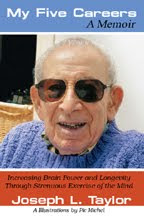
PS: In my previous blogs I have shared excerpts and essays like this one, from my past. My new book entitled, MY FIVE CAREERS: Increasing Brain Power and Promoting Longevity through Strenuous Exercise of the Mind, includes and is based on many of the ideals and illustrations posted at Joe's Place. Look for the book to be released in the Fall. It will be available in paperback at Amazon. I'll let you know more later. Joe
The first time he spoke to me was when he served the coffee at the end of the dinner. After placing the cup and pouring from the silver pot in his hand he said, “I forgot to bring the sugar and cream. After a pause he added shyly, “This my first day her and I don’t remember everything yet.”
Although I have difficulty remembering busboys and waitresses, I had noticed him because he walked as though he was not quite sure of his body and his face had an earnest but unanimated look.
I was sitting alone in the roof top luxury restaurant in a hotel in the
“I don’t use sugar or cream,” I said, “so I don’t mind.” Because he still looked pained I said, “First days can be hard.”
“Yes, but I am trying,” he said. “I graduated from Vocational School
last year and I couldn’t get a job.”
“I’m glad you found one and I wish you the best of luck.”
On the way out I stopped at the reservation desk and asked to speak with the manager. Larry Mullins was his name and after mixing a salad to a table of four, he approached me.
After introducing myself, I said, “I just wanted to say something about your new busboy. I was impressed with how he wants to please people, not only me but I was watching him at other tables. You don’t find too many people like that anymore. I hope he make it.”
“You mean Daniel,” said Mullins. “It’s nice of you to mention it. He is mentally retarded but I mean to keep him. He been out of school a year and I told everyone here that I don’t care what happens, he is going to stay. I can make him learn.
I choked a little, told Mr. Mullins I was glad to hear that. We shook hands and I walked away feeling that this conference for children had already peaked for me.
More Later, Joe

Every age has had its definition of femininity. In recent memory there were the Gibson girl (ample), the flapper (bold, unconventional), Rosie the Riveter, (World War II worker), the Bobby-Soxer, and of course, the Playgirl. Obesity was not in style. The early American woman tended toward sliminess, for among other factors, the hard physical life of a pioneering and the dominance of the farm life kept the weight down.
Concepts of physical attractiveness are, as anthropological studies have shown, malleable. Over the centuries, concepts of female physical beauty have ranged widely each having their day. Venus was the ideal in ancient times; in medieval Europe diminutiveness and daintiness in feet, hands, breasts and long necks were prized; women of some weight are considered desirable in parts of the world (the (Middle East); gaudily painted faces in some cultures (African) are the custom; the short and squat women of the Arctic have no difficulty in finding mates. In contemporary times the suburban, gym-muscled, self-assured woman, a more attainable model than Playgirl, command deep respect. Question: How flexible will the American man now be in his concept of female beauty? Judging from worldwide cultures – and from what I have observed daily in my strolls around my home town (
More Later, Joe
The many scholarly books on the subject describe the newcomers to
First, the common part. These men were tradesmen – bakers, butchers, grocers, peddlers in the commodity-starved rural countryside, small shopkeepers, salesmen. The men made a living for their families, some quite successfully, and blended smoothly into the general life of the city. They were mostly Socialists, victims of cruel, anti-Semitic programs, and without exception were virulently anti-Communist. They voted routinely but futilely in presidential elections for Norman Thomas; and most important for this piece I am writing, they were all members of the Workmen’s Circle, an organization, as the name clearly denotes, for the working man. The Workmen’s Circle had a substantial building of its own on “The Hill” in
A group of perhaps twenty-five men met every Sunday morning for lox and bagels, and for discussions. My father and his younger brother,
Now for the eloquence. These ‘tradesmen” spoke fluidly, colorfully, to the point, with an aggressive intelligence and thorough understanding of the issues on tap that day, political and cultural, from current legislation to literature. Each man seemed to live for these Sunday mornings. They knew it, and put a zest into the proceedings that was infectious. I was amazed. Each man had some schooling in their homeland, some less some more, but they were avid readers of the newspapers and journals -- Yiddish and English. The bond among them and the respect they had for each other was moving. In common, they had survived successfully, first in their flight to
More later, Joe
WILLIAM JAMES, THE PHILOSOPHER, SAID that everyone has as many different selves as there are people who know him. Each person, from his wife and children to the butcher, the baker and the candlestick maker, perceives the same man differently. Ever since I heard that in Philosophy101, I have been confused. Who really am I? Which one of me is the real Joe Taylor? For that matter, who are you? If we don’t even know whom we are how can we ever solve global warming or cure cancer? The guy who figures that out should get two Nobel Prize, one for the day dreaming that is the precursor to original thinking, the second for his solution. I already qualify for one of those talents. The prospect of such riches and fame out there waiting for me to “originate” has temporarily distracted me from writing. Some may think it presumptuous of me to regard myself so highly, but a fact is a fact however absurd. I’d like to say more about that but I emptied the bottle of the stuff I was drinking to gird myself for scribbling this.
How can I not be out of my mind if I have to contend with so many different personalities mixed up in me and battling to be Joe Taylor? May the best man win. But seriously: Auguste Descartes, the French philosopher, said “I think therefore I am.” So, is it our cognitive capacities that define us? Emanuel Kant, the German, said, “I ought therefore I can.” Or is it our moral character? Calvin Coolidge, the President who preceded President Herbert Hoover said, “Business is the business of
More Later, Joe