Sunday, October 11, 2009

The Invisible Pile

There is a big, big pile some where in the world. It is the most enormous pile ever stacked up, disappearing into the infinity of the sky, but you cannot see it. Everyone on earth helped make this heap. Everyone felt real good when they tossed their contributions onto the ever-growing pile, and most people felt bad when, although the pile never stopped growing, it never achieved its purpose. The pile is made up of a very common yet admirable product that, despite its enormity has no visible body. This product has a short expiration date. The most popular growing time is from midnight of January first every year to sometime during the next two weeks. The best of worlds could be constructed from its throwaway contents. It goes by the name of “discarded good intentions.”

I will be calm and reasonable with my three adolescent children; I will absolutely remember our wedding anniversary date and send flowers, the roses that I noticed recently have thorns; I will remember to take out the trash every night without being reminded; be assured that I will take the time to vote for my town’s selectmen because all politics are local and a democracy must start from the bottom; I will not be late for work again (actually, my job is on the line). I will take those two night courses that I need for the job promotion; attend regularly all meetings of our Neighborhood Improvement Association, even those dealing with budgets, and will greet my neighbors in our condo elevator, warmly, as though I meant it. I will even be friendly to Nosy Nancy because I need to charm up my reputation and people will notice. I will visit my mother and take her out to dinner more often and also send her flowers on her birthday. I will patch up the differences I had with Fred, my fat brother-in-law and send New Year cards to all my relatives and friends. I promise to replace every burned-out light bulb immediately and vow to start making a playroom in the basement (the fingers I injured last time I began on it healed a long time ago). No more excuses. I will not honk my horn in traffic and I will get my car inspected on time to avoid penalties. I will make myself a better person of myself in all ways.

There, that says a lot and shows that I am sincere, because it will be a big job. The best thing I can do now is to quit making noise about my good intentions and start the good-intending. I need to go find my tool box. See you on January 1st.

More later, Joe

Tuesday, September 22, 2009

Mother


Laurie retired from her job after a long stint as Director of a school for learning disabled children. She felt that she was burned out. Today, Laurie works part time for a group of doctors, evaluating children for learning and psychological problems; she is a docent at the Peabody Essex Museum in Salem MA; at the Audubon Society on the North Shore of Boston she teaches children about the marshes and animal footprints in the snow; and she was in the leadership group for the extensive volunteer program at her son’s high school Jamie, Laurie’s eighteen-year-old son, is a freshman at George Washington University in Washington D.C. As a child actor, and later in high school, he had leading roles in musicals and stage plays, He sings beautifully (Accepela Choir in high school), tap dances and has an appealing presence. He acquired an immediate celebrity status at George Williams, when, during the first week, he was selected in competition with 300 other students as one of three new voices for the Accepela Choir.


In September, during the second week of classes, Jamie developed Swine Flu. Laurie immediately flew to Washington, had her son transferred from his dormitory room to a hotel suite, nursed him, participated with college personnel in arranging his schedule for after his return, did a host of errands related to his illness and his doctor, and five days later -- including a weekend -- Jamie was back in school. He had missed only three days of classes. After a visit to Alexandria, Virginia (across the Potomac River) to explore a crafts fair, Laurie returned home. She resumed her normal activities the next day. No time out for her.


It will not appear in any record of the medical treatment Jamie received, but I have no doubts that Mother Love was a crucial factor in Jamie’s rapid recovery. That, plus Laurie’s competence, organizational skills and poise under stress, enabled Jamie to utilize his personal resources to combat the illness, free of guilt and other distractions. Mother Love does not come in a pill. It is among the most primitive and ancient of human qualities, and no matter what course evolution, including mutations, have taken place, Mother Love has survived, even grown in its importance to child development. But there are mothers who are emotionally cold, even frigid and rejecting of their children. The most extreme case I saw in my work in a child treatment center was a single mother who did not even want to look at her new born child. There must be many such mothers we never know about. A relative took the child and we never learned what happened subsequently. Many years ago it was the custom to prohibit unwed mothers from seeing their child after birth, under the theory that even a fleeting bonding would damage the child and mother. The noted child psychiatrist, Melanie Klein, believed that maternal rejection was a core element in the development of emotional and mental illness in children, and that bonding occurs immediately, much more quickly than had been thought. Jamie was one of the fortunate children who have a mother who loves him deeply.


I have a photograph of Jamie and me, standing side by side, receiving awards for our prize-winning essays in a literary competition, the youngest and the oldest of the writers. Laurie was a Hospice volunteer in our home, visiting twice a week during my wife’s terminal illness in 2005-2006. We have remained good friends, lunch together frequently, and have dinners along with her husband and my adult daughter and son. Sometimes Jamie would join us for dinner in a restaurant. Random events, such as the Hospice assignment of Laurie, simply happen, but our lives become better when we utilize chance to our advantage.


photo courtesy of aussiegall under a CC2.0 license


Wednesday, September 9, 2009

End of an Era

I just cancelled my subscription to a daily newspaper after sixty-eight years of subscribing in Chicago, Cincinnati, St. Paul, Philadelphia and to the Boston Globe. No, I am not losing my eyesight, nor am I running out of money or moving to Paris, where like a proper Parisian, I will read Le Monde. It's simply that I am fed up with what the papers write about and the predictability. Actually it is not their fault. They are only the messengers for the newsmakers. The chief culprit is Congress. The Senate and House have lots of meetings, but little of genuine significance to the nation ever happens. The journals have to put out an edition every day. How can they do it if there is no news? By re-cycling the same story over and over and over with slight modifications to stress presumably, but often softball NEWS – REPUBLICANS BLAST OBAMA ON BUDGET, or DEMOCRATS FAULT GOP ON CLIMATE CHANGE.CHANGE. The story could be about Social Security or Medicare or drug lords and their cohorts and clamping down on crime (while the prison population soars, or a scandal involving celebrities, or getting divorced or having a baby, or a child killed by a parent who should have had his parental rights terminated or been sent to jail a long time ago ,or a back and forth in arguments about gun control, or -- enough, you get the point. What will I do? I'll think about other former necessities that are now not worth my time.

More Later, Joe

Monday, September 7, 2009

Post Nuptual Agreement

A husband and wife are sitting in the den after dinner. He is reading a newspaper and she is sitting at a desk writing a letter. In the background a stereo is playing Chopin piano music. She turns her chair around to face him.

She: (stops writing) I’ve been thinking. I want to buy you a new wristwatch.

He: A new watch? I have a watch, it’s old, but it still works. Thanks, but one is enough for me.

She: It’s not for now. I want you to have something to remember me by.

He : In that case you can buy me a gold Rolex. I’ll remember you real good.

She: You don’t’have to remember me that much.

He: (Lowers the newspaper to his lap) What’s this remembering business? Are you trying to tell me something?

She: Why do you have to have to read a meaning like that into a simple offer? I just want you to have something to remember me.

He: If I go first you will have wasted your money.

She: (She ignores that) Another thing. You will say Yarhzeit for me when the time comes, the way you do for your parents on the anniversary of their death? That is if your second wife won’t object.

He: I can’t believe it! Is that what this is all about? Forget it, there won’t be a second wife.

She: Every man needs a wife to take care of him.

He: It will be expensive but I’ll take my shirts to the laundry.

She: Have I been such a bad wife that you would not want to be married again?

He: Mmmm. let me think about that. (He pretends to think). No, I wouldn’t say that. It’s just that to be fair to another wife I’d have to show her that I care and I can’t see myself wanting to put that much into a wife again.

She: That’s nice.

He: Besides, considering my age and whom I would marry it could end up that I’d have to take care of her. To paraphrase your favorite poet: “In caring there is responsibility”.

She: You might have to take care of me some day.

He: That’s different. You’ve earned that right.

She: Fifty-six years is a long time. What was the best part?

He: There was no best part. It was all good.

She: You don’t mean that. A marriage is never “good” all the time. Like the time we quarreled when you wanted to go to Prague and I wanted to go to Budapest. C’mon tell me the best part.

He: The whole was better than the parts – satisfied now?

She: I knew it! Some parts were not good. (She laughs.) Remember the Mikado we saw in Sarajevo? Katishaw was ugly but she was said to have a beautiful left elbow.

He: I remember the seats were $1.70 and you sat next to the English lady who was married to the Lord High Executioner. It was opening night and people were all dressed up in and it was televised. That was the best Mikado I ever saw. It was a good trip. (They fall silent).

She: One more thing. We talked about it but we never did anything about the cemetery lots. Shouldn’t we do something now?

He: Well, with both kids living north of Boston we should buy plots up there. It’ll be handy if they want to drop by once in a while.

She: Remember to talk to the kids next time we see them.

He: Besides, at the rate our friends are dying off, it’ll get pretty lonely around here. We should probably move up there sometime soon.

She: I’ve been thinking about that, too. (they fall silent).

She: I’m finished interrupting. You can go back to your newspaper. (he resumes reading, she returns to her letter).

April 3, 1990

More Later, Joe

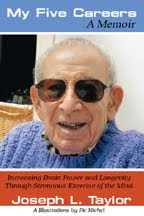
PS: In my previous blogs I have shared excerpts and essays like this one, from my past. My new book entitled, MY FIVE CAREERS: Increasing Brain Power and Promoting Longevity through Strenuous Exercise of the Mind, includes and is based on many of the ideals and illustrations posted at Joe's Place. Look for the book to be released in the Fall. It will be available in paperback at Amazon. I'll let you know more later. Joe


Friday, September 4, 2009

The Busboy

The first time he spoke to me was when he served the coffee at the end of the dinner. After placing the cup and pouring from the silver pot in his hand he said, “I forgot to bring the sugar and cream. After a pause he added shyly, “This my first day her and I don’t remember everything yet.”

Although I have difficulty remembering busboys and waitresses, I had noticed him because he walked as though he was not quite sure of his body and his face had an earnest but unanimated look.

I was sitting alone in the roof top luxury restaurant in a hotel in the Colorado Mountains awaiting the start of a Child Welfare League of America on children and youth. None of my friends had yet arrived and so I had no company for dinner. The inexpensive hotel coffee shop on the ground with its air of transience and filled with men and women eating quickly to get to their next appointment, was uninviting. Loneliness encourages me to extravagance, I found my way to the hotel’s luxury restaurant. Surrounded by elegance and pampered by an attentive staff. I had worked my way to the coffee.

“I don’t use sugar or cream,” I said, “so I don’t mind.” Because he still looked pained I said, “First days can be hard.”

“Yes, but I am trying,” he said. “I graduated from Vocational School

last year and I couldn’t get a job.”

“I’m glad you found one and I wish you the best of luck.”

On the way out I stopped at the reservation desk and asked to speak with the manager. Larry Mullins was his name and after mixing a salad to a table of four, he approached me.

After introducing myself, I said, “I just wanted to say something about your new busboy. I was impressed with how he wants to please people, not only me but I was watching him at other tables. You don’t find too many people like that anymore. I hope he make it.”

“You mean Daniel,” said Mullins. “It’s nice of you to mention it. He is mentally retarded but I mean to keep him. He been out of school a year and I told everyone here that I don’t care what happens, he is going to stay. I can make him learn.

I choked a little, told Mr. Mullins I was glad to hear that. We shook hands and I walked away feeling that this conference for children had already peaked for me.

More Later, Joe

Tuesday, August 25, 2009

Further Thoughts on the New Feminine


As if we don’t have enough portentous questions to solve, let me add another. Who will replace the vanishing Playboy Magazine “Playgirl” as the next popular ideal of American Beauty? With obesity in both sexes already beyond fifty-percent and growing, can the longings of the American male accommodate themselves to the reality of the New Feminine, or – or what?

There is a self-parodying joke about the Jewish man who, when told that the elephant population in a region of India was declining at an alarming rate, asked if that was good or bad for the Jews? We must ask, is the eclipse of the long-legged, slim and admirably proportioned, high-cheeked, sexy woman good or bad for men?

Every age has had its definition of femininity. In recent memory there were the Gibson girl (ample), the flapper (bold, unconventional), Rosie the Riveter, (World War II worker), the Bobby-Soxer, and of course, the Playgirl. Obesity was not in style. The early American woman tended toward sliminess, for among other factors, the hard physical life of a pioneering and the dominance of the farm life kept the weight down.

Concepts of physical attractiveness are, as anthropological studies have shown, malleable. Over the centuries, concepts of female physical beauty have ranged widely each having their day. Venus was the ideal in ancient times; in medieval Europe diminutiveness and daintiness in feet, hands, breasts and long necks were prized; women of some weight are considered desirable in parts of the world (the (Middle East); gaudily painted faces in some cultures (African) are the custom; the short and squat women of the Arctic have no difficulty in finding mates. In contemporary times the suburban, gym-muscled, self-assured woman, a more attainable model than Playgirl, command deep respect. Question: How flexible will the American man now be in his concept of female beauty? Judging from worldwide cultures – and from what I have observed daily in my strolls around my home town (Salem MA), he will meet the test of gallantry.

Did I say male sexual selection – and I could add female sexual identity – is malleable? In fact it seems that men and women will buy whatever happens to be in stock at the time. Maybe sexual selection should be noted and reviewed in the fashion magazines, the way high skirts-low skirts and tight jackets-loose jackets are critiqued.

More Later, Joe

Friday, August 14, 2009

The Eloquence of the Common Man

The many scholarly books on the subject describe the newcomers to America as “waves of immigrants and “hordes of New Americans;” refer to their habitats on the Lower East Side of Manhattan as “tenements” and “railroad chain cold water flats”. The streets were described as teeming with “rickety pushcarts’ and their goods for sale; and filled with children at play, dodging pedestrians and street vehicles, shrieking with joy while putting pedestrians at risk. amidst the squalor, this iconic site is also home to one of the great stories of/in the growth of America. The years were the last quarter of the 1800’s –1915. Except for the novels and short stories about the lives of immigrants, the sociological treatises fail to convey an understanding of these flesh-and-blood people. Let me tell you about a small community of Jewish men in Wilkes-Barre, PA, many from Russia, Poland, and Romania, as I knew them during the years 1927-1935.


First, the common part. These men were tradesmen – bakers, butchers, grocers, peddlers in the commodity-starved rural countryside, small shopkeepers, salesmen. The men made a living for their families, some quite successfully, and blended smoothly into the general life of the city. They were mostly Socialists, victims of cruel, anti-Semitic programs, and without exception were virulently anti-Communist. They voted routinely but futilely in presidential elections for Norman Thomas; and most important for this piece I am writing, they were all members of the Workmen’s Circle, an organization, as the name clearly denotes, for the working man. The Workmen’s Circle had a substantial building of its own on “The Hill” in Wilkes-Barre, called “The Lyceum,” that served as a forum on social and political issues, and as a cultural center for the continuity of Jewish life.


A group of perhaps twenty-five men met every Sunday morning for lox and bagels, and for discussions. My father and his younger brother, Israel, were as close and affectionately attached as any brothers I have known. We visited Israel and his family several times a year and each Sunday my father, with me in tow, attended the morning meetings at the Lyceum. Some members dressed in suits, others in sweaters. Of the many intriguing experiences I had at these gatherings, the one I remember most is the weekly “redde” session, the Yiddish word for speakers and speech-makers, -- everyone spoke Yiddish -- and the subsequent discussions.


Now for the eloquence. These ‘tradesmen” spoke fluidly, colorfully, to the point, with an aggressive intelligence and thorough understanding of the issues on tap that day, political and cultural, from current legislation to literature. Each man seemed to live for these Sunday mornings. They knew it, and put a zest into the proceedings that was infectious. I was amazed. Each man had some schooling in their homeland, some less some more, but they were avid readers of the newspapers and journals -- Yiddish and English. The bond among them and the respect they had for each other was moving. In common, they had survived successfully, first in their flight to America, and then in becoming Americanized and acquiring citizenship. Israel spoke one Sunday about his escape from Lithuania, a real thriller (discussed at length in my book). Every man had a story. At the time I knew these men they were in the prime years of life. I often wonder, with gratitude for what they taught me, how the remainder of their lives turned out.


More later, Joe